

Treatment, Prevention and
Recovering From Prostate Cancer
Story by Michael Seguin
Photography by John Liviero
Our community was shocked to discover that Mayor Drew Dilkens was recently diagnosed with prostate cancer. And while Mayor Dilkens remains in fine spirits about both his surgery and his recovery, the news has spurred several discussions about the illness and ways we can prevent and treat such a condition.
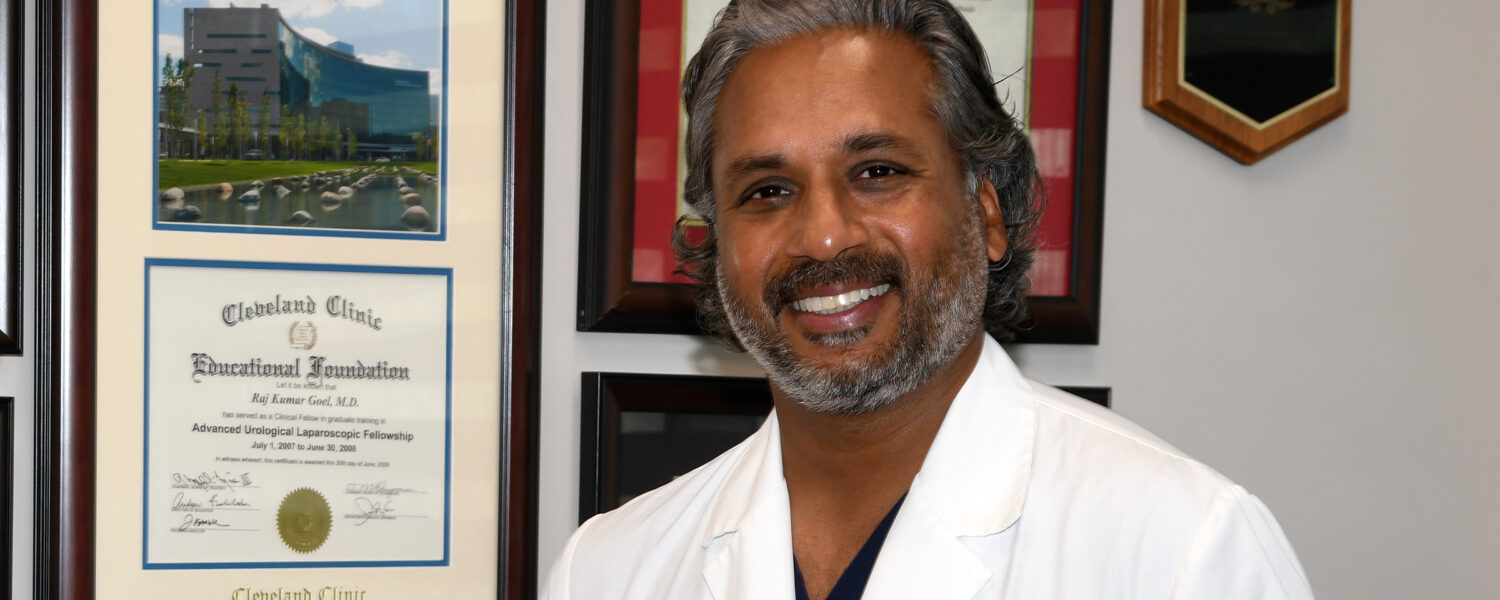
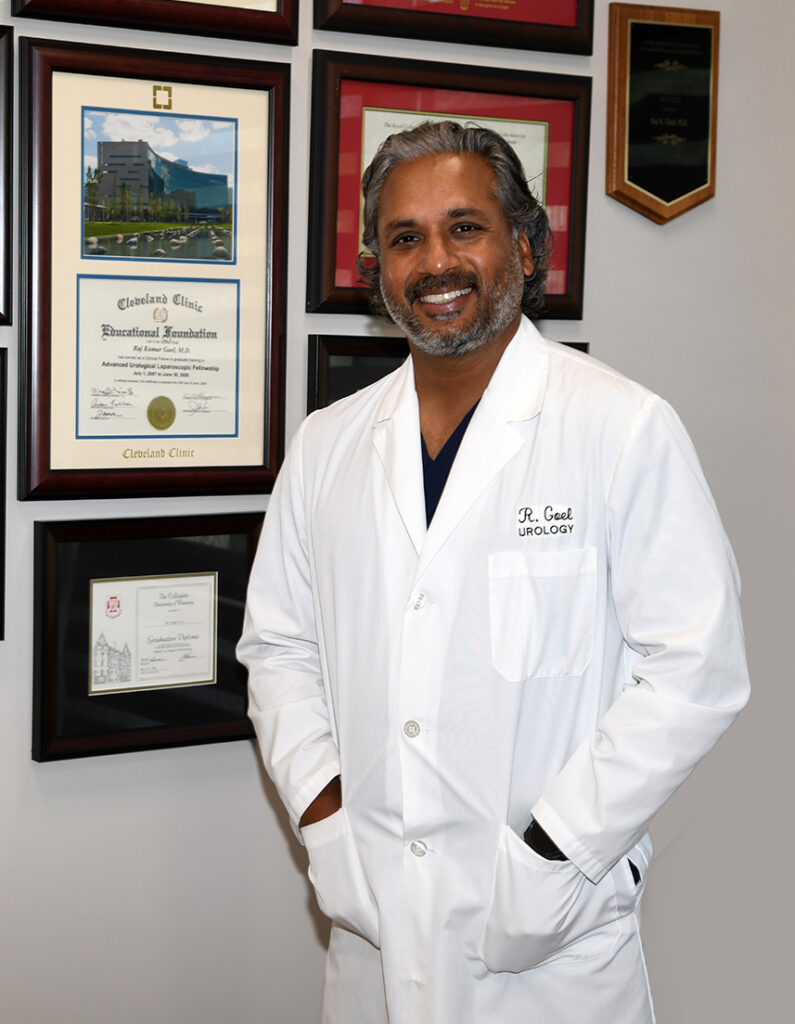
One such discussion took place between Windsor Life Magazine and Dr. Raj Goel, an esteemed local urologist. A graduate of the University of Manitoba and Halifax’s Dalhousie University, he later obtained a two-year Fellowship from the Cleveland Clinic studying Advanced Laparoscopic and Robotic surgery. He has currently spent the last sixteen years serving our community by identifying and treating prostate cancer.
“Prostate cancer is unfortunately a very common aliment in urology,” Dr. Goel explains. “We see a lot of patients crossing our path. For myself, I believe I naturally developed an interest in diagnosis and treatment just because of the sheer volume of cases we see.”
And according to Dr. Goel, the challenge with prostate cancer is more in the diagnosis than the treatment.
“Prostate cancer is unique in that it is very much an asymptomatic disease,” Dr. Goel states. “It’s difficult to identify in terms of strictly physical symptoms. A lot of it is detected solely through bloodwork—specifically the prostate-specific antigen (PSA) test. Based on the PSA value changes and occasionally based on the absolute value, it can help facilitate detection.
Once the results of the tests have been obtained, a patient might then undergo a prostate biopsy, which can then lead to a formal diagnosis.
“In addition to that, a physical test involving a digital rectal exam can also help us detect prostate cancer as well,” Dr. Goel explains. “So again, it can be very hard to detect. Unless men present themselves to a family physician or a primary care provider and explicitly seek out the PSA test or vice-versa, that’s the only way we can narrow down a diagnosis.”
And the positive results of such early testing cannot be understated. According to Dr. Goel, prostate cancer screening has led to a stage migration and better long-term outcomes against prostate cancer.
“We recommend annual PSA blood tests starting at age fifty in men,” Dr. Goel stresses. “If there is a positive family history of prostate cancer with a first-degree relative diagnosed with prostate cancer below the age of 65, then we suggest earlier testing—usually around forty-five.”
And once a diagnosis has been obtained, the second part of any cancer detection involves identifying the current staging of the disease.
“Based on the severity of the cancer, patients would then undergo a bone scan and CAT scan to rule out the spread of the disease to other sites within the body,” Dr. Goel states. “If those tests come back negative, then the patient takes the wheel in terms of both surgical and non-surgical options. In terms of surgery, we now use the da Vinci Surgical Robot to remove the entire prostate. Alternatively, there are radiation techniques that involve external beams or brachytherapy.” Our job now becomes to educate the patient and to provide a wholistic approach as to the options related to prostate cancer treatment.
Fortunately, the chances of recovery for such an ailment are consistently trending positive.
“Because of this early detection pathway and because patients have hopefully been screened soon enough to identify prostate cancer in its infancy, the prognosis has certainly improved,” Dr. Goel explains. “The chances of recovery are even more positive if you look at surgical and radiation therapy techniques and advancement in technology—and even some adjunct treatment methods in the future.”
And the range of effective recovery methods are numerous.
“The multitude of treatments for patients with more advanced cases has dramatically grown over the last five to seven years,” Dr. Goel states. “For these certain cases—where the cancer has unfortunately spread to the bones or lymph nodes—we have an array of new methods. Oral medications. Chemotherapies. Immunotherapies—which are fairly recent new options. We also have what’s called theragnostic pathways, which are treatment algorithms we use through PET scans. These all give us significantly more tools for attacking prostate cancer in its more aggressive forms.”
But perhaps the most significant factor in terms of recovery, Dr. Goel stresses, is early detection through the PSA tests.
“Doctors have attempted to reduce prostate cancer risk through various long-term studies,” Dr. Goel explains. “We’ve looked at things like mineral compounds such as Selenium or Vitamin E to see if they can even reduce the risk of the disease. Unfortunately, there is no current diet or lifestyle one could achieve that would eliminate the risk of prostate cancer. Early studies involving metabolic implications and obesity and its effect on prostate cancer evolution is also being studied. So, there is nothing we have now that’s preventive. Which is another reason why an early diagnosis is so serious.”
That said, what continues to inspire and motivate Dr. Goel is the many, many successful recovery stories that he witnesses each and every day.
“I’ve come across a lot of patients, being in this city for the past sixteen years,” Dr. Goel states. “I’ve glimpsed firsthand how life-changing prostate cancer is. It’s done two things. One, it’s made patients take much better care of themselves. Diet. Exercise. Being more mindful of their long-term health. So, it’s very gratifying seeing patients living life to the fullest and taking such good care of themselves. And on the surgical side of things, it’s so inspiring seeing patients return to their normal way of life after the stress leading up to the procedure and the recovery. Seeing my former patients out in the world and being a part of the community again is just so rewarding. And I get to see all this on a daily basis.”
So, while our city is still reeling from our mayor’s diagnosis, we can all breathe a little easier knowing that medical professionals like Dr. Goel are attending to him and overseeing his treatment. And for those of us who meet the criteria for an increased risk of prostate cancer, obtaining a PSA test as soon as possible can mean the difference between life and death.
Published in the Anniversary 2025 Edition.

Add comment