

Alaina Ha’s Advocacy is Reshaping Accessibility in Emergency Response For The Deaf Community
Story/Photography by Paula Just
Inclusion and accessibility are often discussed as abstract ideals. However, meaningful progress usually starts locally, inspired by lived experience and the willingness to ask simple yet important questions. In Windsor-Essex, a significant change has been driven by a young voice that refused to accept barriers as inevitable.
Alaina Ha, a deaf Grade 8 student at Our Lady of the Annunciation Catholic Elementary School in Stoney Point, has helped shine a light on accessibility gaps in emergency response. Her advocacy has contributed to greater awareness around lifesaving equipment and the availability of text-with-911 services for the Deaf and the hard-of-hearing community across the region.
Alaina’s first journey into advocacy began during a standard first aid training session at her school. Paramedics from Essex-Windsor Emergency Medical Services visited the classroom to teach students CPR and how to use an automated external defibrillator (AED). For most of the class, the lesson was straightforward. For Alaina, it was difficult.
“As I was learning the first AED machine, it made me feel kind of nervous,” she recalled through Danielle Boomer, her interpreter. “It gave me a pause to figure out if I could use this machine and do it safely.” The standard AED relied primarily on voice commands, forcing Alaina to depend on her American Sign Language interpreter to understand each step. “I had to look up to my interpreter often to comprehend what the machine was saying,” she shared. “And that made me think that if I were out in the community or an emergency was happening, there would not be an interpreter there.”
When Alaina shared her concerns with the paramedics, they introduced a different AED, a model manufactured by ZOLL that includes captions, images and video instructions. The experience changed completely. “When I used that machine, I was able to understand it on my own,” Alaina said.
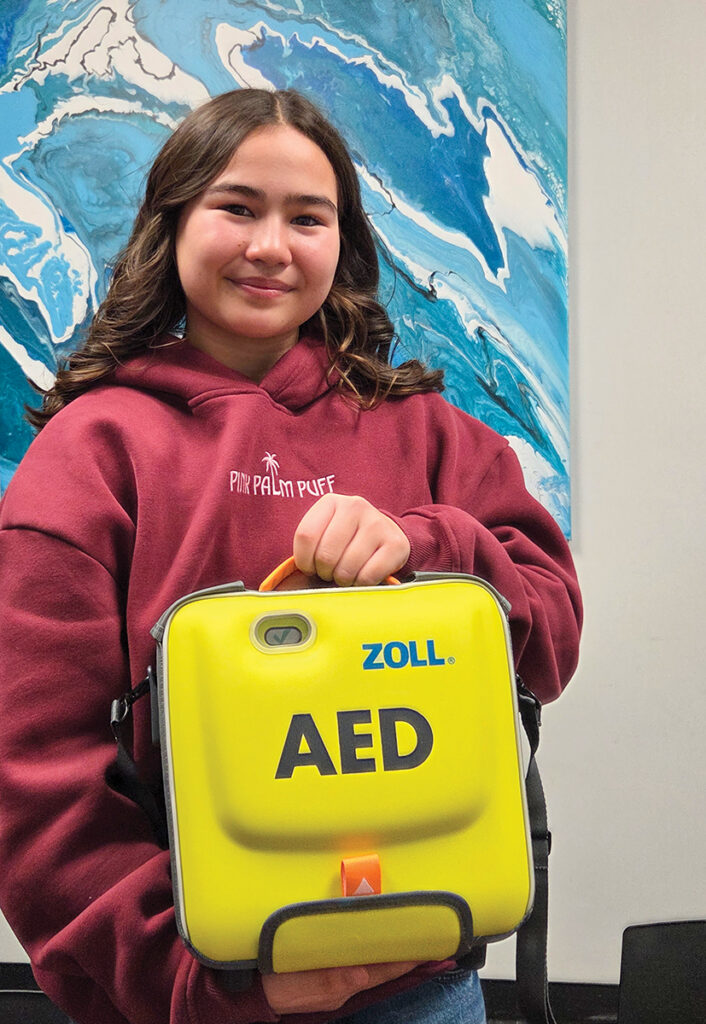
EMS Chief Justin Lammers, who was present during the lesson, recalls that with this equipment, the student was able to act independently. “She flew through the scenario on her own and never needed to look to the interpreter once,” he said.
It was a clear indication that many standard AEDs are not designed with hard-of-hearing users in mind. “In a real situation, that would be a safety issue for me, being able to understand what needed to be done without someone telling me,” Alaina declared.
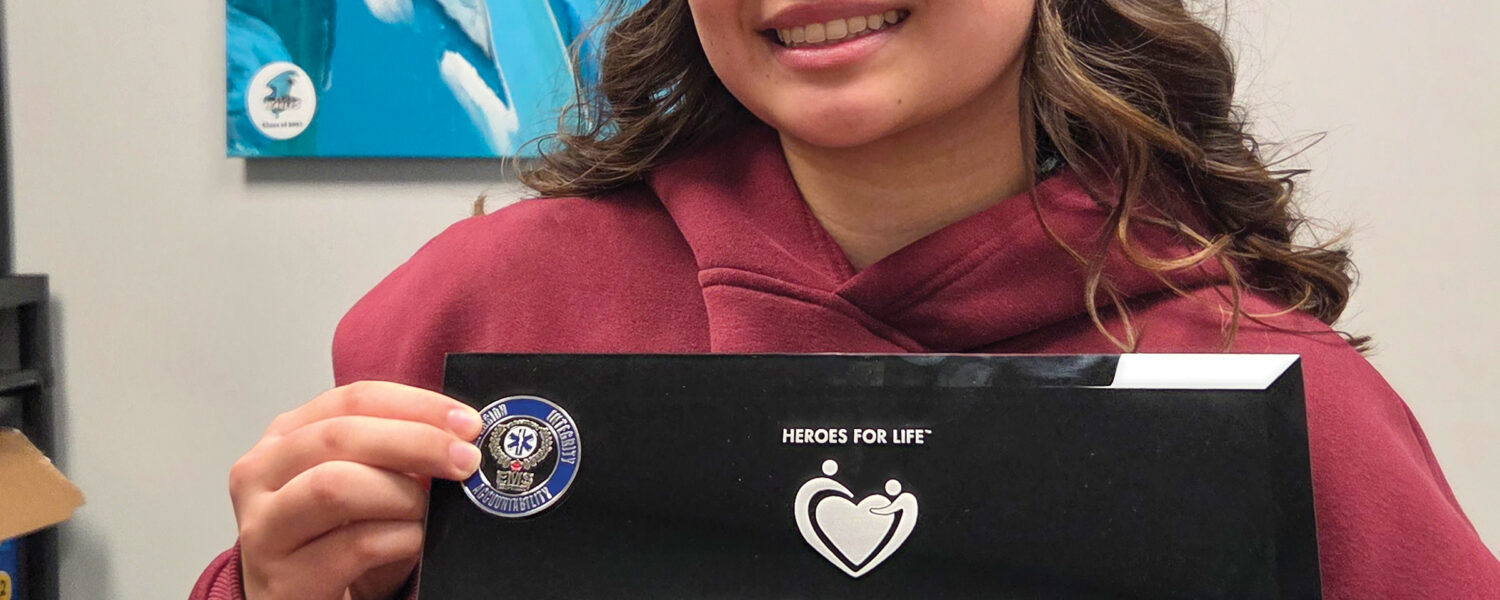
Rather than leaving the experience behind, the student decided to act. She wrote a letter to ZOLL, explaining how the visual AED technology benefited her. In response, the company recognized her initiative and later donated a specially designed AED.
“I felt very surprised when the company answered me,” Alaina admitted. “But I also felt that I could do something to help other deaf people and make something more accessible.” Her questioning also earned her a certificate of recognition from the company, the Heart Safe Award.
The AED experience and learning about emergencies led Alaina to question another scenario: how would a deaf person contact 911 in a crisis? “I realized I wouldn’t feel comfortable calling 911 because I don’t speak, hear or use a phone that way.”
Her questions led EMS to further examine their systems and promote the availability of text-with-911, a service that allows registered users to communicate with emergency dispatchers via text rather than voice. “Texting is what I’m comfortable with and what we use often,” she explained. “So having text-to-911 available is really important.”
For Alaina, the impact is clear. “It gives deaf people a way to connect with 911 and get an immediate response,” she said. “There isn’t a delay and it is not getting someone else involved. It’s being able to contact the service independently.” Chief Lammers says Alaina’s experience prompted emergency officials to take a closer look at accessibility gaps. “She made us realize that more work needed to be done to make the community more aware of the ability of those who are Deaf or hard-of-hearing,” he stated.
Residents should be aware that text-with-911 requires pre-registration. Deaf and hard-of-hearing individuals must contact their cellphone service provider in advance to enable the feature. All the information is now available on the County of Essex website’s Make the Right Call page: countyofessex.ca/maketherightcall.
For Teresa Laporte, principal of the school unit, Alaina’s initiatives are truly remarkable. “She’s not only talking for students, but for the deaf people and for herself,” Teresa affirmed. “For a 13-year-old to understand what she needs to be successful in a hearing world, that’s a skill not a lot of people have. As an educator, it’s a proud moment.”
According to Teresa, Alaina’s leadership is evident both in and out of the classroom. “She can’t hear, but she communicates in her own way, getting around the building with her strengths and her bubbly personality,” she said. That presence is just as strong on the court, as the teenager plays several sports, including volleyball, basketball and badminton. “Her voice is heard through her actions and all her teammates follow her lead,” the principal added.
Teresa believes that this success is the result of a collective commitment to inclusion within the school, which is part of the Windsor-Essex Catholic District School Board. She says creating an environment where students feel supported is a shared responsibility among all educators, regardless of whether they experience accessibility challenges.
“I think it’s about recognizing that deafness is not a disability but rather an ability that requires accessibility through ASL Interpreters. We all have challenges,” she explains. “We need to make sure everybody feels confident. It’s about getting to know our students and inspiring them to be the best versions of themselves.”
Beyond her academic life, Alaina enjoys fishing during the summer and dreams of becoming a veterinarian. These last experiences gave her a deeper sense of awareness and she says she will continue to be attentive to the obstacles society imposes on the Deaf community. As her story continues to spread, she hopes her message reaches others who may hesitate to speak up. “I want to advocate that all deaf people can do anything,” she affirmed.
She also hopes her experience raises awareness of barriers that are often invisible to those who do not face them. “We can do anything just like anyone else and don’t need to depend on a hearing person. There is no inequality when it comes to being unable to hear.”
Published in the February/March 2026 Edition.

Add comment