


A Venerable Medical Visionary Looks Toward
The Future For Windsor-Essex Healthcare
Story by Jesse Ziter
Photography by Heike Delmore
Windsor Life catches up with the pioneering ophthalmologist to learn more about the new Windsor Surgical Centre, the “Windsor Model” for modern eye surgery, how a COVID-19 silver lining may get you a faster hip replacement, and how, after nearly four decades in Windsor, his most consequential work may still be ahead of him.
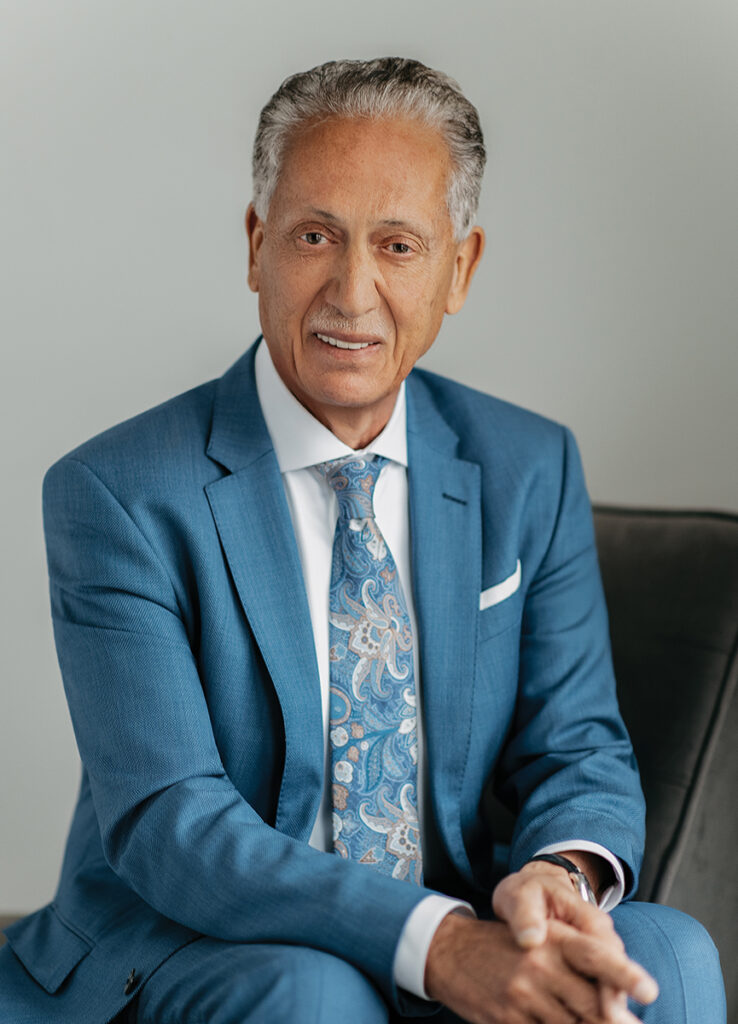
Dr. Fouad Tayfour, one of the most successful Windsorites in living memory, assures me he’s fine.
“I was fine before,” stresses Tayfour, best known as founder and medical director of the Windsor Laser Eye Institute (WLEI) but today discussing his role in the private Windsor Surgical Centre (WSC). “I’m blessed to have done very well financially from the beginning; to think that motivates me now is a misconception. I just love the city, and I want Windsor to have what it deserves.”
Since 1988, the Syrian-born eyecare expert has performed tens of thousands of LASIK procedures, pioneered multiple cataract surgeries, and built the most comprehensive and efficient ophthalmology program in Southwestern Ontario by recruiting subspecialists in oculoplastic, cornea, glaucoma and retinal surgery.
Increasingly, what Tayfour believes Windsor-Essex residents deserve is access to the greatest level of surgical care—both within and outside the traditional hospital system.
The WSC, which Tayfour co-owns with the ophthalmologist Dr. Barry Emara is a potentially transformative investment in out-of-hospital care in our region. Located at 10700 Tecumseh Road East in Windsor, the state-of-the-art facility hosts thousands of procedures every year via partnerships with Windsor Regional Hospital (WRH) and the Ontario Ministry of Health, freeing up scarce resources at the Hospital’s main campuses.
The WSC operates in accordance with the Ontario Ministry of Health’s Quality-Based Procedures (QBP) and community surgical and diagnostic centres programs. The Ministry touts both arrangements as mechanisms for funding healthcare services outside traditional hospital settings in specific cases where patients can be treated effectively at better value for public money.
According to Tayfour, seeds for the QBP program—and so the WSC—began to germinate in 2020, when COVID-19 measures abruptly cancelled all elective procedures at WRH. Tayfour credits David Musyj, then the hospital’s president and CEO, for liaising with the Ministry of Health to secure special permission for WRH to relocate certain ophthalmology cases to the private Walker Road Facility that still houses the WLEI, as it wasn’t subject to the same lockdown restrictions. After a brief spell operating there, the WSC opened shop at its 12,000-square-foot eastside facility in 2022.
Today, QBP surgeries are administered across the pro-vince by local hospital networks (in our case, WRH) that effectively contract offsite operating rooms in private facilities. Tayfour-owned ophthalmology facilities in Kitchener-Waterloo and Barrie participate in the program, hosting procedures via agreements with local hospitals using what he calls “the Windsor model.”
In 2023, the WSC’s relationship with the Ministry evolved meaningfully as it was rechristened an Independent Health Facility (now a licensed community surgical centre). Unlike the QBP program, this newer scheme directly funds private facilities that perform low-risk, outpatient surgeries; care remains free to patients at the point of access through the Ontario Health Insurance Plan (OHIP).
“We have a special license to perform cataract surgery with direct funding from the Ministry of Health,” says Tayfour, noting the arrangement has allowed for a 60-percent increase in patient care capacity, ratcheting wait times down to two weeks. “I am proud of this benchmark, and I dedicate my time to ensuring this is the standard of care across Ontario.”
In December, the Ministry made the WSC one of four private clinics in Ontario permitted to perform orthopedic surgeries— and the only such facility also licensed for ophthalmology. The WSC will host total knee and hip arthroplasties, life-changing procedures for which Windsor-Essex residents currently endure longer-than-average waits. The well-known surgeon Dr. Greg Jasey will lead its orthopedic team.
According to Tayfour, the Ministry intends for the WSC to accommodate 2,000 orthopedic procedures annually by 2027, which will require three to four dedicated operating rooms. An entirely new facility for orthopedic surgeries is in the planning stages.
According to many stakeholders—Tayfour, Emara, Musyj, and Jasey among them—the WSC’s model plainly works. “For any outpatient procedure, it’s much more economical to do it outside the hospital,” Tayfour explains, “because the Ministry saves costs associated with hospital buildings—like heating and cooling. For the medical care itself, the Ministry pays the same money for the same service.”
Moreover, in Tayfour’s words, the government scheme “releases pressure on hospitals,” freeing up space for more complex procedures with associated overnight stays. “We have the wait times we do because the hospitals are at capacity. If you give them room to do something different, that helps everybody. Hospitals should be for acute care: things that need to be done there.”
Because OHIP still foots the bill, WSC patients are referred by their primary care providers in the normal way and are simply given the facility address. The Ministry expects equivalent care, so patients need not choose between surgical sites.
“Nobody would elect to go to the hospital, anyway,” Tayfour assures me. “The WSC is a beautiful facility, with tonnes of free parking. As a patient, you go in, have your surgery and go home.”
Tayfour expects this arrangement to hold even after Windsor-Essex’s long-gestating “mega-hospital” is up and running. In the medium term, he hopes the province will deliver a first-class facility capable of supporting the research needs of a full-fledged, independent medical school.
I just love the city, and I want
Windsor to have what it deserves.
While Windsor has hosted a satellite campus of Western University’s Schulich School of Medicine and Dentistry since 2008, Tayfour has greater aspirations for the region. “Building an independent medical school here is my dream and my main drive,” he insists, stressing that ambitious medical specialists need to live and work in regions with elite teaching institutions. “Not for me—I don’t like teaching anyway—but so that the next generation of first-class specialists train, practice and become active members in Windsor.”
Until then, “Windsor-Essex remains an afterthought at the highest levels of medicine,” he laments. “Our system serves more than 400,000 people—not a small volume! If you go to Toronto, you can find a hospital that looks like the Four Seasons. We pay tonnes of taxes here, but we get nothing for it, comparatively. Why?”
It is hard to say Tayfour, a major regional philanthropist, hasn’t done his part to change the status quo. Through his Tayfour Family Foundation, bolstered by generous contributions from Emara, he has invested millions of dollars to sustain and advance healthcare-related research.
If Tayfour is at all consumed by the breadth of his intra-provincial portfolio, he doesn’t give it away. Most days, he commits to a neat eight-hour shift in the surgical suite at the WSC, completing 40 to 50 procedures before 3:30 p.m. (The industry average, he tells me, is about 20 cases per day).
“To succeed, you need to have a good team and know how to delegate,” he explains. “I have the vision, but I have good people around me. They take it from there.
“My easiest days are when I’m in doing surgery,” Tayfour continues. “In the office, you have to talk too much. I enjoy what I do, and I am still the best at it, regardless of what anybody will tell you.”
He pauses, just long enough for a smile to form at the corners of his mouth: “It’s not actually work, treating people. I have more free time than anybody.”
Published in the February/March 2026 Edition.

Add comment