

Creating Upcycled Musical Instruments
Story by Matthew St. Amand
Photography by Tyler Middlebrook
Music is a mysterious mystical language that is singularly human. The instruments upon which music is created are often finely made objects of exacting craftsmanship: pipe organs, wind instruments, guitars, pianos, to name but a few. The hurdy-gurdy is an instrument of particular sophistication and intricacy that was first made in medieval times. Contrary to what many might believe, the oldest musical instrument in the world is not a drum, but a flute made from the bone of a bird that has been carbon dated to be more than 60,000 years old—created by Neanderthals, no less.
Chatham resident, Noel Marentette, has been a musician for sixty years. In recent years, he has taken to creating “upcycled environmentally friendly” musical instruments out of materials he finds while on walks.
“I play guitar, banjo, lap steel slide, mandolin and mountain dulcimer,” Noel says. “I started playing when I was fourteen years old. My uncle had a garage band, and he showed me how to play the guitar. I don’t read music.”
Noel has always made a point of sharing his love of music, particularly the guitar.
“Whenever I see a playable, old guitar in a second-hand shop, I usually buy it, clean it up and restring it,” Noel explains. “One time, I found a cheap, playable parlour guitar at a thrift shop. As I stood in line to pay for it, I noticed a mom and her son behind me, and the little boy was really eying the guitar. After paying for it, I paused at the exit and when the mom and her son came through, I gave the guitar to the boy. He lit right up and ran to the car with it!”
Beyond the guitar, Noel says that he has always had an interest in vintage stringed instruments from different parts of the world. At one point, about a dozen years ago, he decided to try his hand at creating a playable stringed instrument.
“I got inspiration from watching some videos online, people making ‘canjos’ and other homemade instruments constructed of found materials,” Noel says. “And I thought to myself: ‘Jeez, maybe I can make some stuff on my own.’”
A canjo is a stringed instrument that makes use of a can for the body, a length of wood as its neck, plus at least one string.
Noel continues: “I’m not a wood worker. My first canjo was a ‘trial and error’ project. Not many people make this kind of stuff.”
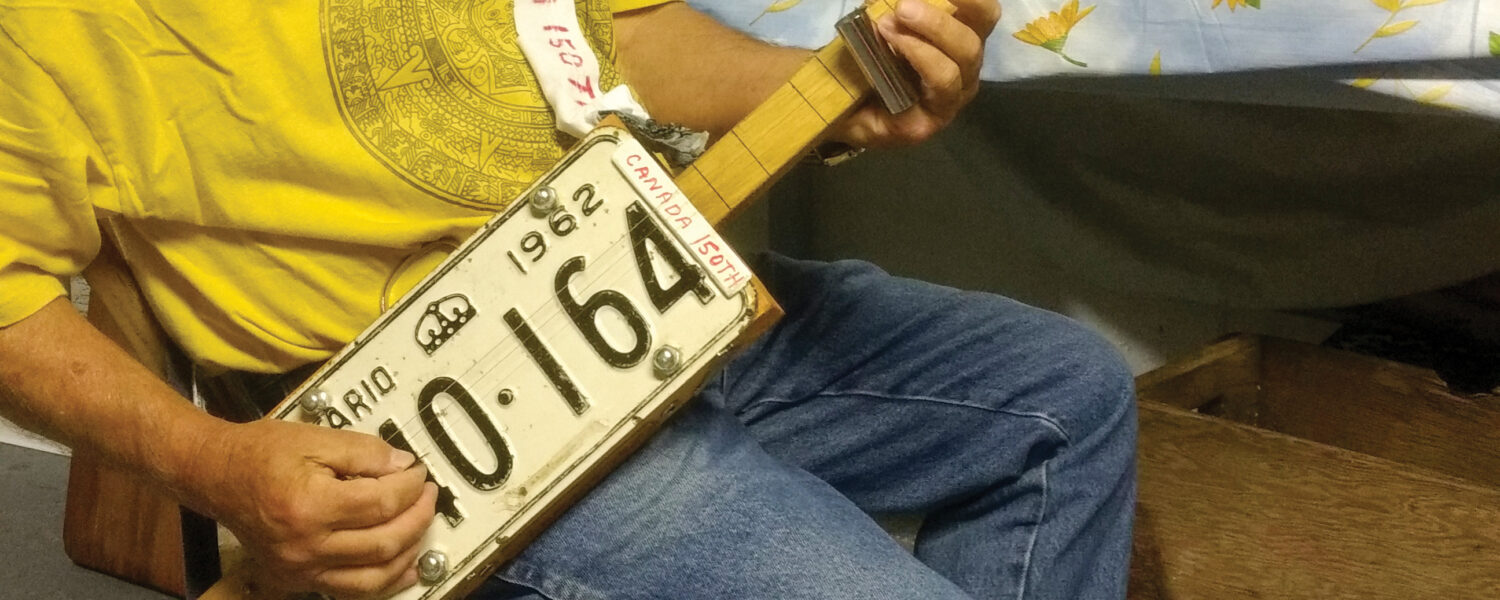
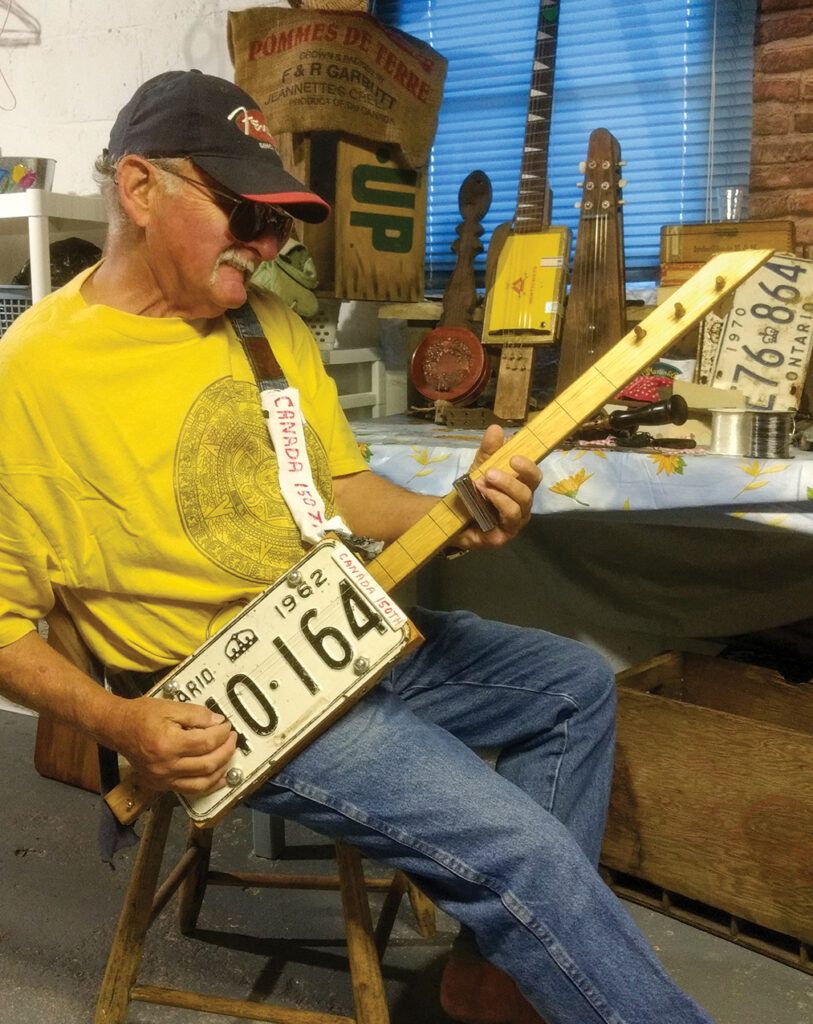
Among the first projects Noel undertook, he commemorated Canada’s 150th birthday, in 2017, by constructing a box guitar using a 1962 Ontario license plate for its face, which fronted a small body comprised of a wooden box. Noel hand-whittled the instrument’s tuning pegs and used bolts for its nut and bridge. The tools he used were few, but included a hand-crank drill to make holes, and a steak knife to carve out slots in the headstock.
On the instrument’s body, Noel inscribed four things he felt best represented Canada: Vimy Ridge, Terry Fox, hockey and Canadian whisky. Best of all, the instrument can be tuned and played.
Enjoying the challenge of creating such instruments, he went on to create a Paw Patrol-themed canjo for a four-year-old family member.
“When he got it,” Noel says, recalling the young family member’s initial reaction to the gift, “he was grinning. That is priceless.”
Where does Noel find the materials he uses for creating his instruments?
“When fabricating my canjos, my motto is: ‘Use what you got,’” he says. “I will be out on a walk and see a vintage box, or anything else that looks usable and interesting. I go for walks in different places; around where factories used to be or old transport parks. I find all kinds of unexpected items. I stay away from plastic.”
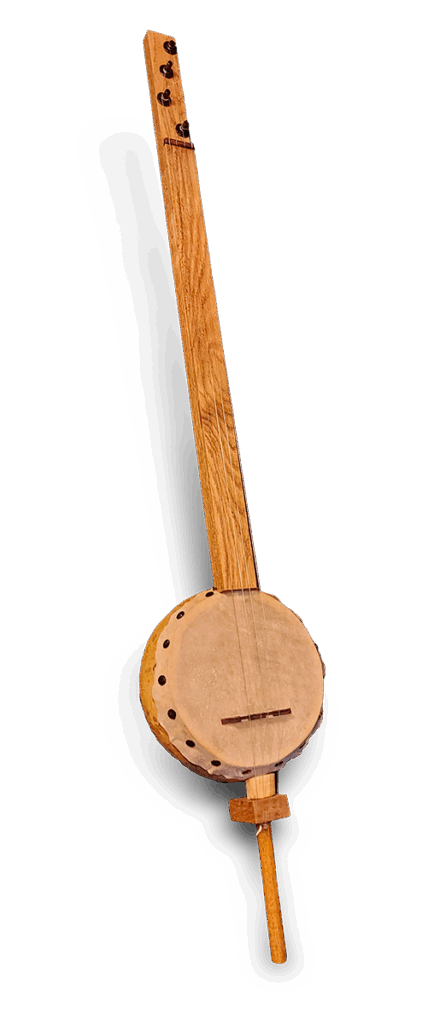
After that project, Noel turned his hand to crafting a handmade banjo. He used a gourd (hard vegetable) for the body, hollowed it out and stretched a piece of goat skin over the sound hole.
“The instrument is fretless,” Noel says. “You have to navigate for the notes, use hammer-ons, pull-offs or a slide.”
He explains that gourd-body stringed instruments go back decades in the Ozarks.
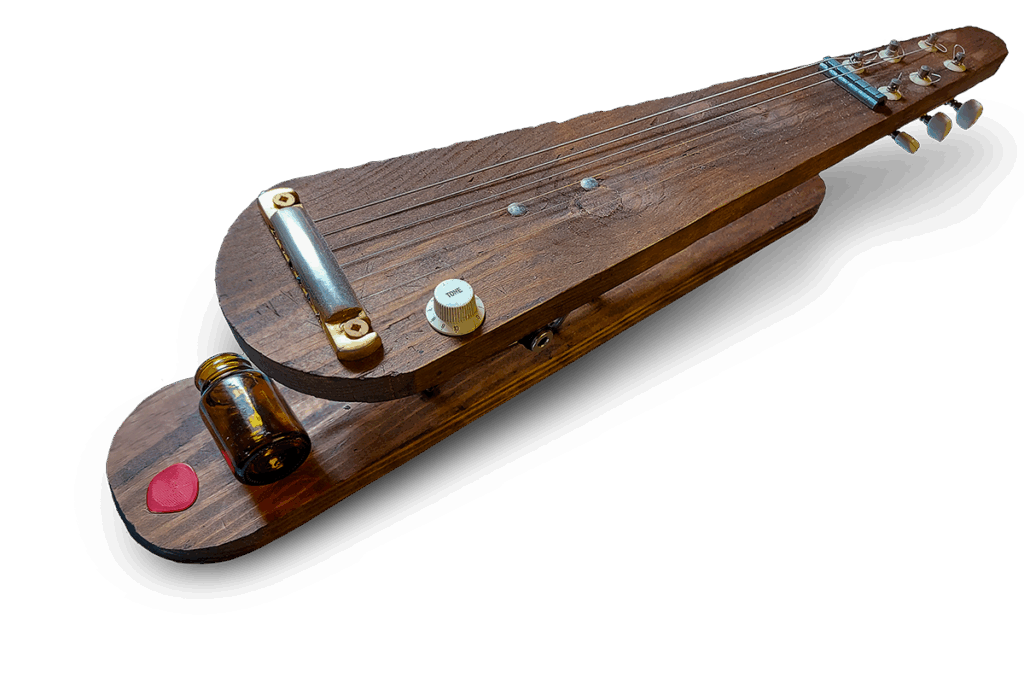
One morning, Noel was out in his car looking for some “treasures” to inspire a new instrument. This outing did not leave him disappointed. He found a single, stray crutch in his travels.
“Ironically, I found it in the same neighbourhood where I’d lived sixty years ago!” Noel recalls. “I stopped and picked it up and immediately saw the possibilities of what this old crutch could be transformed into.”
When he got it home, Noel wasted no time transforming the crutch into a six-string slide guitar with an electric pick-up, so it can be amplified. It was featured in the “Our Canada” column in Readers’ Digest Canada.
It is the process of creation that motivates Noel. He tends to give away these instruments as gifts to friends—or people who simply love music—so there is unfortunately no trove of instruments for the public to view.
He estimates he has created approximately one hundred instruments, some going to locales as far away as Nova Scotia, the Philippines and India, in the hands of friends and admirers.
“I create these instruments for the challenge,” Noel says. “I don’t do it to outdo anyone or to prove anything. It’s the challenge of taking different things, cleaning them up, straightening them out, piecing them together and then hearing the sound they make when I am done. The response I have gotten from people is overwhelming.”
He adds with a laugh: “The craft itself is like trying to make a silk purse out of a sow’s ear!”
In recent years, Noel has created fewer and fewer instruments. He also does not play music all that often, anymore.
“Arthritis is creeping in,” he says. But he does fondly remember the many instruments he has created in the past dozen years and reflects upon all the pleasure they have brought to the people who received one as a gift, or who had simply heard the strange, beautiful music they make.
To learn more about his instruments, Noel can be contacted at noelmarentette@hotmail.com.
Published in the September 2025 Edition.

Add comment